Company Data Ops Series · Research workflow
Stop asking interns to Google 500 companies
Every research team has done some version of this: export a list of company names, open a spreadsheet, assign it to an intern or analyst, and ask them to fill in website, industry, location, description, and “anything useful.” It sounds simple. It is not.
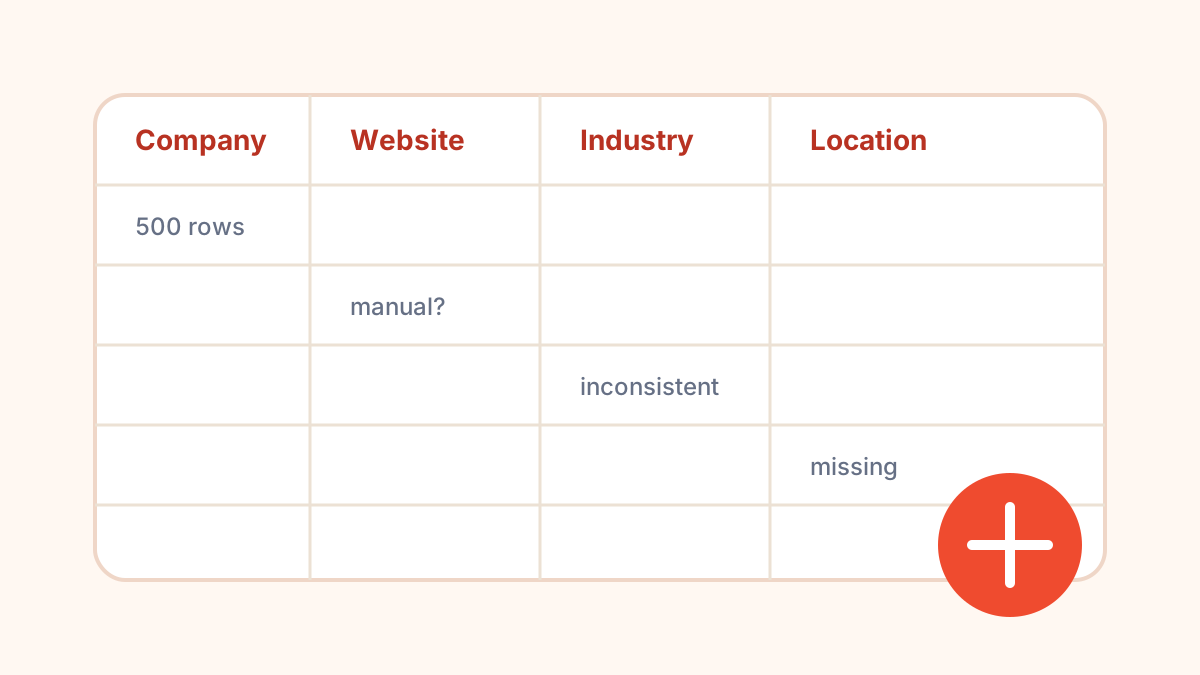
The first 20 rows feel fine
Manual research feels reasonable when the list is small. Search the name, find the website, skim the homepage, copy a short description, guess an industry, move on.
Then the edge cases arrive:
- Three companies have the same name in different countries.
- The company changed names last year.
- The website is down, parked, or redirects to a parent company.
- The industry is not obvious from the homepage.
- One analyst writes “AI,” another writes “Software,” another writes “Enterprise SaaS.”
By row 200, your spreadsheet is not a clean dataset. It is a collection of tiny human decisions made under time pressure.
The hidden cost is inconsistency
The problem with manual company research is not just that it takes time. It is that different people create different rows. One researcher writes full sentences. Another writes fragments. One includes headquarters. Another includes operating regions. One treats funding as important. Another ignores it.
That inconsistency makes the final dataset harder to use. You cannot reliably filter it. You cannot easily compare companies. You cannot build a dashboard without cleaning the cleanup.
A better division of labor
The best workflow is not “replace humans.” It is “stop wasting human judgment on repetitive first-pass collection.” Let automation collect the obvious fields, then use people for review, interpretation, and decisions.
- Input: a spreadsheet of company names.
- First-pass lookup: website, description, industries, location, size, optional funding.
- Completeness check: flag rows with missing or weak fields.
- Human review: inspect ambiguous matches and high-value accounts.
- Final export: send clean rows to CRM, dashboard, or report.
A spreadsheet-friendly row
input_name,website,industry,location,size,description,review_status
Stripe,https://stripe.com,Payments,San Francisco,1001-5000,Financial infrastructure platform,ok
Acme,,Unknown,,,"No confident public profile found",review
The second row is not a failure. It is exactly what a good workflow should surface: “do not blindly trust this; review it.”
How to avoid creating another messy spreadsheet
- Use fixed columns. Do not let every researcher invent their own structure.
- Separate source and judgment. Store returned profile data separately from analyst notes.
- Use controlled values when possible. Industry and region fields should not become free-text chaos.
- Flag uncertainty. Missing website, missing industry, or vague descriptions should be visible.
- Sample before bulk processing. Test 25–50 rows before running 5,000.
Where a company lookup API fits
A company profile lookup endpoint can handle the repetitive middle: take a company name, return a structured profile object, and let your workflow write it into rows. That is most useful when your list is too large for manual first-pass research but still important enough to review intelligently.
const output = {
  input: companyName,
  website: company.website ?? null,
  industries: company.industries ?? [],
  location: company.location ?? null,
  size: company.size ?? null,
  review: company.website ? "ok" : "review"
};
What success looks like
A good outcome is not “we never used humans.” A good outcome is:
- Researchers spend time on ambiguous/high-value companies.
- Rows have consistent structure.
- Missing data is visible instead of hidden.
- The final spreadsheet can actually be filtered, sorted, and imported.
If you want to automate the first pass
The ShakeChillies company enrichment endpoint can help turn company names into structured rows with website, description, industries, location, size, and optional funding fields. It is best used as a first-pass research helper, not a replacement for review.
Try the company lookup endpoint
Disclosure: this guide is maintained by ShakeChillies. The API is not an official Crunchbase product. Some fields may be missing, so treat nulls as normal and design review steps around them.