Company Data Ops Series · KYB
The boring data problem behind KYB onboarding
KYB teams talk about document checks, beneficial ownership, sanctions screening, fraud signals, and risk models. But many onboarding workflows still get slowed down by a much more ordinary problem: the submitted business name arrives with almost no usable company context.
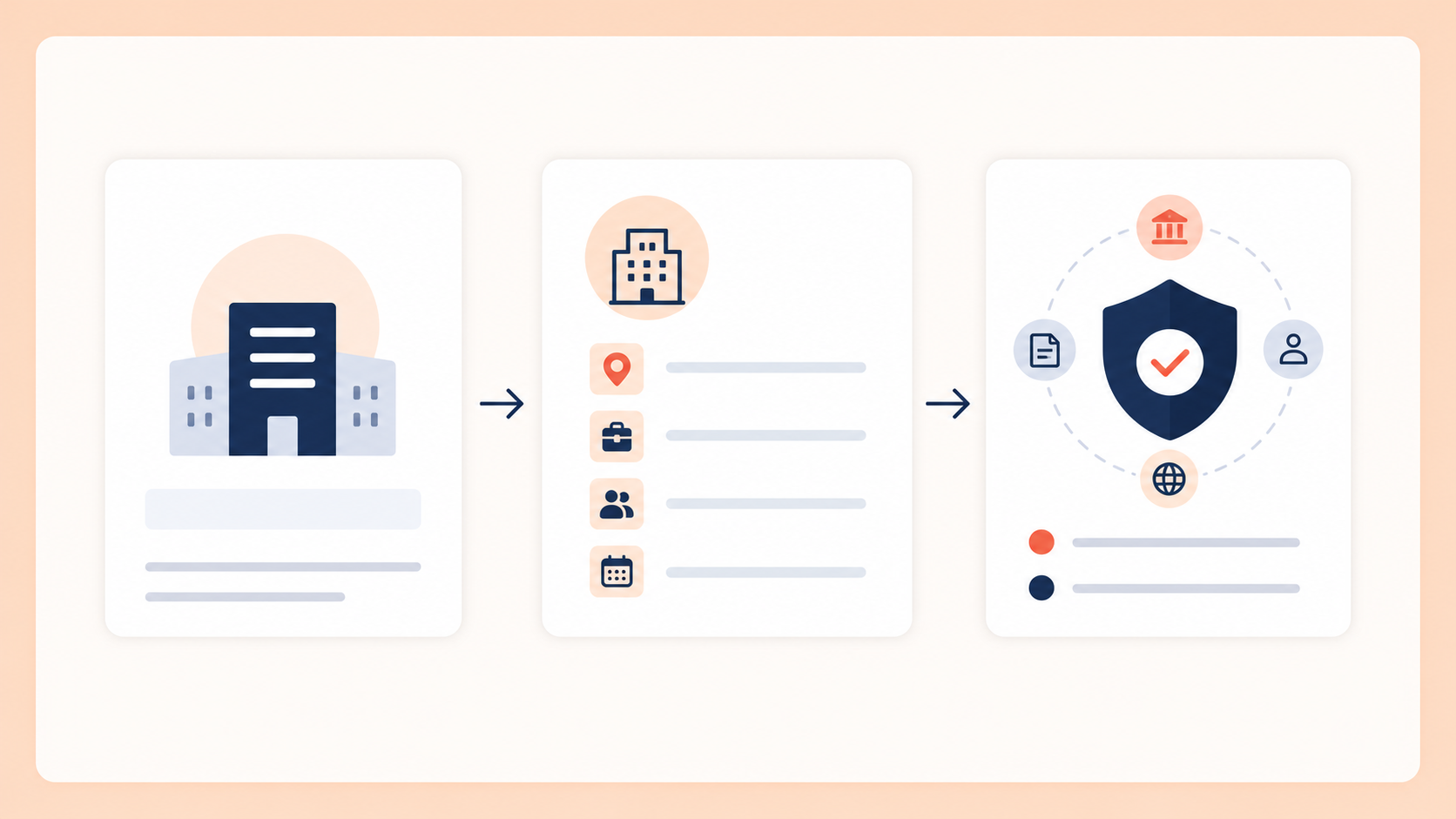
A business submits a name. Maybe there is a website. Maybe not. Maybe the name is a legal entity name, a trade name, a brand, a parent company, or a slightly misspelled version of something real. Before a reviewer can decide what to do next, they need context.
Company context is not KYB - but KYB often needs it
Let’s be precise: a company profile lookup does not replace KYB. It does not verify beneficial owners. It does not screen sanctions lists. It does not determine whether a business should be approved.
What it can do is support the operational layer around KYB. It can help your system or reviewer answer basic questions earlier:
- Does this business appear to have a public website?
- What does the company appear to do?
- Where does it appear to be based?
- Which industry or category does it seem to belong to?
- Is the profile sparse enough to require manual review?
The pain: every unclear company becomes a tiny research task
When onboarding volume is low, reviewers can Google each business manually. At scale, that becomes expensive and inconsistent. One reviewer checks the website. Another checks LinkedIn. Another copies a description from a search result. The notes are different, the process is hard to audit, and the queue gets slower.
This is especially painful when most businesses are not suspicious. They are just incomplete. You do not want a high-friction process for every normal record. You want enough context to route obvious cases faster and save human attention for the rows that actually need it.
A useful pre-review row
A practical context layer might look like this:
{
  "submitted_business_name": "Example Labs Ltd",
  "website": "https://examplelabs.com",
  "description": "Software tools for logistics operators.",
  "industries": ["Software", "Logistics"],
  "location": "London, England, United Kingdom",
  "profile_completeness": "medium",
  "review_flags": ["industry_present", "website_found"],
  "funding_usd": null
}
This row does not make a compliance decision. It makes the next human or system step easier.
What to flag for review
The most valuable part of this workflow is often not the enriched fields themselves. It is the review logic you build around missing or conflicting data.
- No website found: route to manual review or request more information.
- Very generic description: avoid using it as a strong risk signal.
- Location mismatch: compare submitted country with returned profile context.
- Unclear industry: assign a reviewer rather than guessing.
- Missing funding: treat as normal, not suspicious by itself.
Why the stakes are higher in KYB
In sales ops, bad company data creates messy routing. In KYB, bad assumptions can create operational and compliance risk. That is why the workflow should be conservative. Enrichment should add context, not overclaim certainty.
FATF’s beneficial ownership work emphasizes the importance of adequate, accurate, and up-to-date information on who owns or controls companies. A company profile lookup is not a beneficial ownership source, but it can be part of the surrounding intake and triage process.
A simple pattern
- Accept the submitted business name and website if provided.
- Look up company context from a profile source.
- Store returned fields separately from user-submitted fields.
- Generate completeness and mismatch flags.
- Route only the unclear or high-risk rows to deeper manual review.
If you want a company context endpoint
The ShakeChillies company enrichment endpoint can help populate basic business profile context: website, description, industries, location, size, and optional funding. In KYB-style workflows, it should be used as a pre-review context layer, not as a compliance decision engine.
Disclosure: maintained by ShakeChillies. This article is operational content, not legal advice. The API is not an official Crunchbase product and does not replace regulated KYB, KYC, AML, sanctions, or beneficial ownership checks.